using OptimalControl
using NLPModelsIpopt
using DifferentialEquations
using Plots
using Plots.PlotMeasures
using LaTeXStrings
using Roots
function SIRocp(tf, S0, I0, Q, β, γ, umax)
    ocp = @def begin
        t ∈ [0, tf], time
        x = (S, I, C) ∈ R^3, state
        u ∈ R, control

        S(0) == S0
        I(0) == I0
        C(0) == Q

        C(tf) ≥ 0.0

        0 ≤ u(t) ≤ umax

        0.0 ≤ I(t) ≤ 1.0
        0.0 ≤ S(t) ≤ 1.0

        ẋ(t) == [-(1 - u(t)) * β * S(t) * I(t),
                    (1 - u(t)) * β * S(t) * I(t) - γ * I(t),
                -u(t)]

        -S(tf) → min
    end

    sol = solve(
        ocp, :collocation, :adnlp, :ipopt;
        scheme = :gauss_legendre_3,
        grid_size=1000,
        tol=1e-9,
        display=true,
    )
    return sol
end
SIRocp (generic function with 1 method)
tf   = 300
γ    = 0.2
S0   = 0.999
I0   = 0.001
Q    = [28 , 10.]
β    = [0.6, 0.9]
umax = [1  , 0.5]

sol1 = SIRocp(tf, S0, I0, Q[1], β[1], γ, umax[1])
sol2 = SIRocp(tf, S0, I0, Q[2], β[2], γ, umax[2])
• Solver:
  ✓ Successful  : true
  │  Status     : first_order
  │  Message    : Ipopt/generic
  │  Iterations : 63
  │  Objective  : -0.08320123801849659
  └─ Constraints violation : 1.144216665860398e-11

• Boundary duals: [-0.10727017446402387, -0.04419195143918839, 0.006500193797238698, -0.006500193797238698]
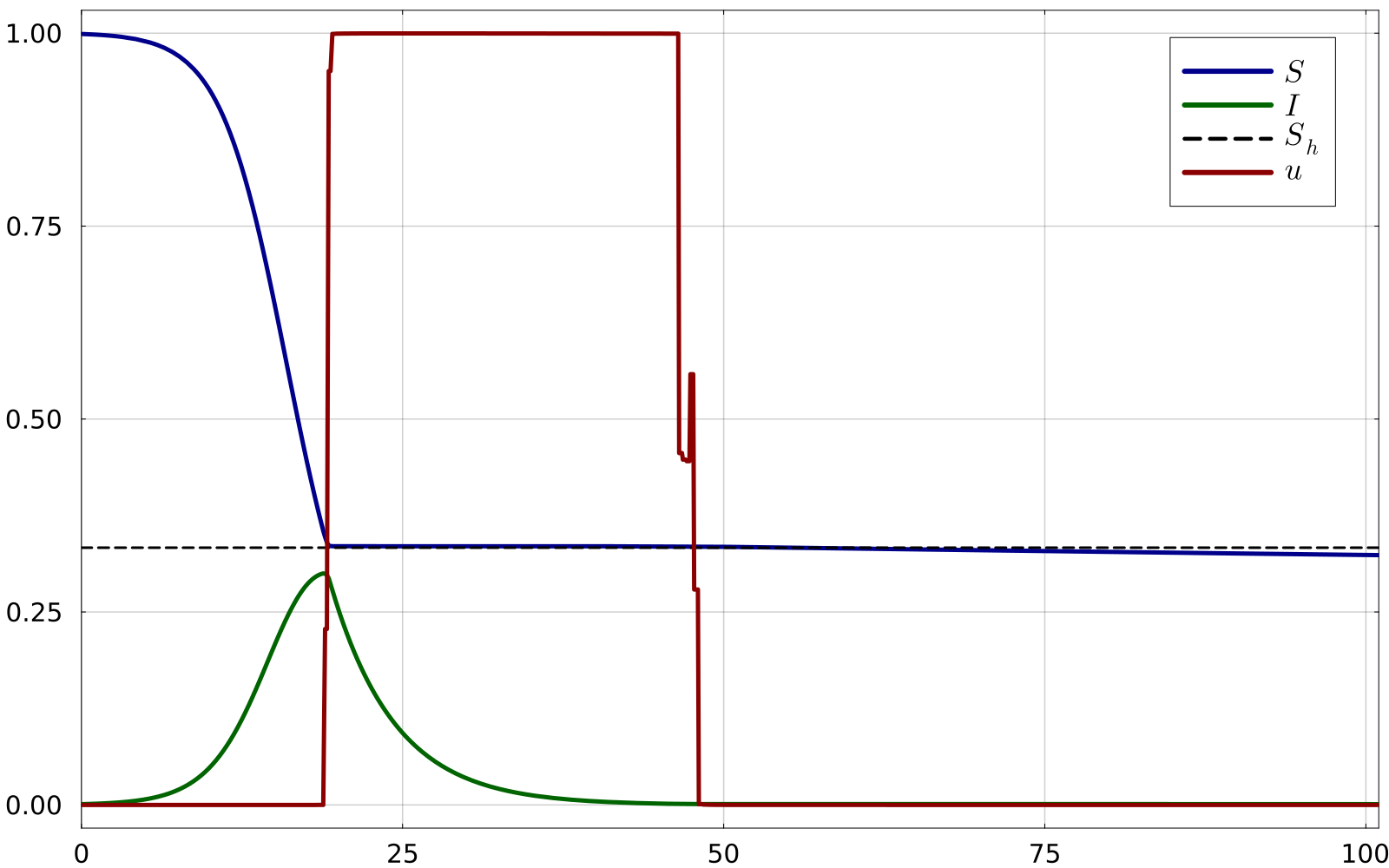
plot(
    t -> state(sol1)(t)[1], 0, tf,
    label = false, color = :darkblue, lw = 5,
    grid = true,
    gridlinewidth = 1.5,
    size = (1600, 1000),
    legendfontsize = 24,
    tickfontsize = 20,
    guidefontsize = 26,
    framestyle = :box,
    foreground_color_subplot = :black
)

plot!(
    t -> state(sol1)(t)[2], 0, tf,
    label = false, color = :darkgreen, lw = 5
)

plot!(
    [0, tf], [γ/β[1], γ/β[1]],
    label = false, lw = 3, ls = :dash, color = :black
)

plot!(
    t -> control(sol1)(t)[1], 0, tf,
    label = false, color = :darkred, lw = 5
)
plot!([NaN], [NaN], label=L"$S$", lw=2, color=:darkblue)
plot!([NaN], [NaN], label=L"$I$", lw=2, color=:darkgreen)
plot!([NaN], [NaN], label=L"$S_h$", lw=1.5, ls=:dash, color=:black)
plot!([NaN], [NaN], label=L"$u$", lw=2, color=:darkred)
xlims!(0,101)
gr()
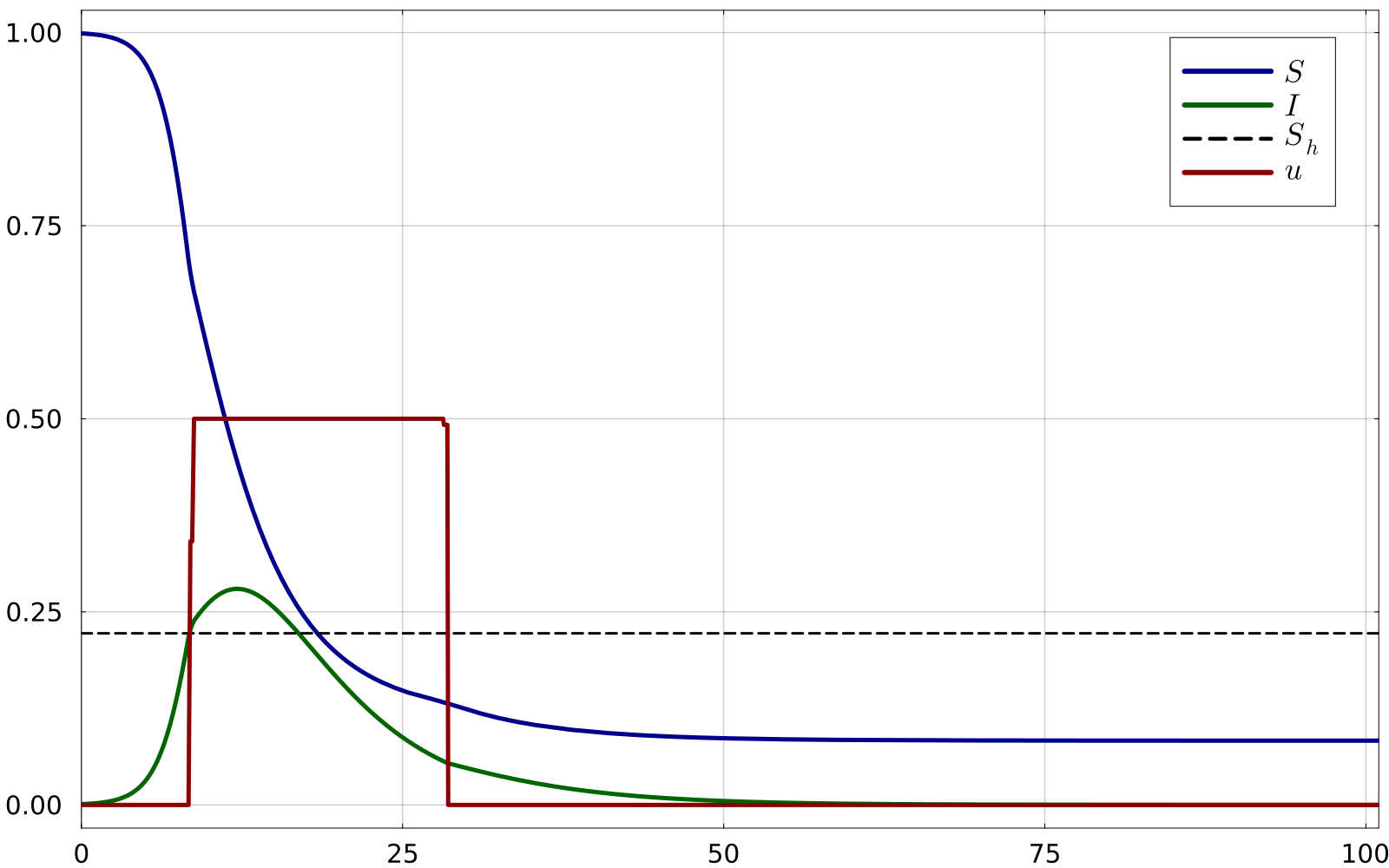
plot(
    t -> state(sol2)(t)[1], 0, tf,
    label = false, color = :darkblue, lw = 5,
    grid = true,
    gridlinewidth = 1.5,
        size = (1600, 1000),
    legendfontsize = 24,
    tickfontsize = 20,
    guidefontsize = 26,
    framestyle = :box,
    foreground_color_subplot = :black
)

plot!(
    t -> state(sol2)(t)[2], 0, tf,
    label = false, color = :darkgreen, lw = 5
)

plot!(
    [0, tf], [γ/β[2], γ/β[2]],
    label = false, lw = 3, ls = :dash, color = :black
)

plot!(
    t -> control(sol2)(t)[1], 0, tf,
    label = false, color = :darkred, lw = 5
)

# Dummy lines for thin, clean legend entries
plot!([NaN], [NaN], label = L"$S$",   lw = 2, color = :darkblue)
plot!([NaN], [NaN], label = L"$I$",   lw = 2, color = :darkgreen)
plot!([NaN], [NaN], label = L"$S_h$", lw = 1.5, ls = :dash, color = :black)
plot!([NaN], [NaN], label = L"$u$",   lw = 2, color = :darkred)
xlims!(0,101)
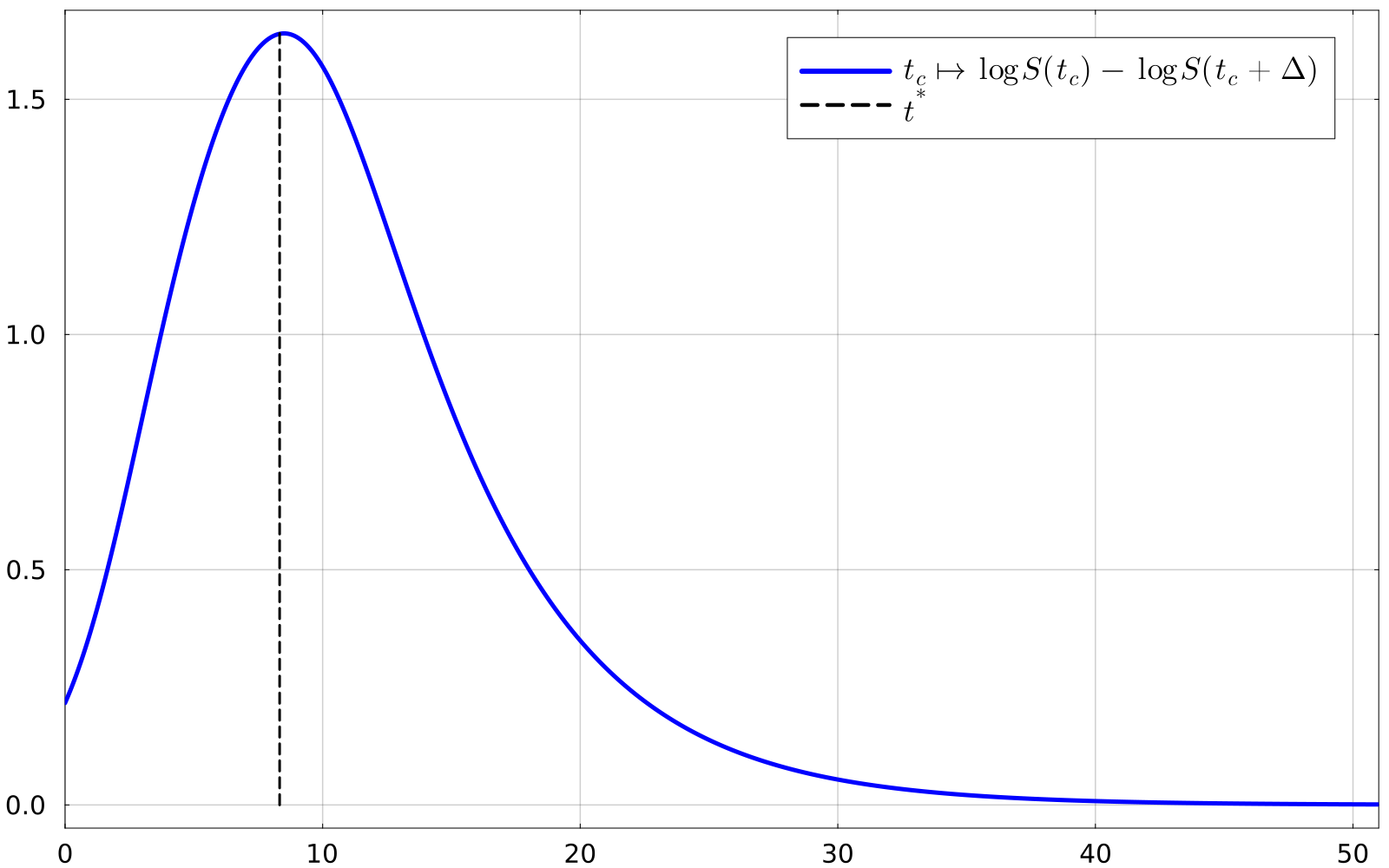
ϕ2(t) = (costate(sol2)(t)[1]-costate(sol2)(t)[2])*β[2]*state(sol2)(t)[1]*state(sol2)(t)[2] - costate(sol2)(t)[3] # switching function
t2 = find_zero(ϕ2, (0.0, 20), Bisection())
8.330042210932813
Δ2 = Q[2] / umax[2]

tspan = (0.0, tf)

function control__(t, tc)
    if t ≥ tc && t ≤ tc + Δ2
        return umax[2]
    else
        return 0.0
    end
end

function sir!(du, u, p, t)
    S, I = u
    tc = p
    u_val = control__(t, tc)
    du[1] = -(1 - u_val) * β[2] * S * I
    du[2] = (1 - u_val) * β[2] * S * I - γ * I
end

tcs = 0.0:0.05:(tf-Δ2)
result_values_ = Float64[]

for tc in tcs

    prob_ = ODEProblem(sir!, [S0, I0], tspan, (tc))
    sol_ = solve(prob_, Tsit5(), abstol=1e-12, reltol=1e-12)
    if tc >= first(sol_.t) && tc <= last(sol_.t) && (tc + Δ2) >= first(sol_.t) && (tc + Δ2) <= last(sol_.t)
        S_tc = sol_(tc)[1]
        S_tcD = sol_(tc + Δ2)[1]

        val = log(S_tc) - log(S_tcD)
        push!(result_values_, val)
    else
        push!(result_values_, NaN)
    end
end
gr()

plot(
    tcs, result_values_;
    label = false,
    lw = 5,
    grid = true,
    gridlinewidth = 1.5,
        size = (1600, 1000),
    legendfontsize = 24,
    tickfontsize = 20,
    guidefontsize = 26,
    framestyle = :box,
    color= :blue)

plot!(
    [t2, t2], [0, 1.64],
    linestyle = :dash,
    lw = 3,
    label = false,
    color = :black
)

plot!([NaN], [NaN], label = L"t_c \mapsto \log S(t_c) - \log S(t_c + \Delta)", lw = 2, color = :blue)
plot!([NaN], [NaN], label = L"t^*", lw = 1.5, ls = :dash, color = :black)
xlims!(0,51)